Showing posts with label children's literature. Show all posts

Meet Becky Gehrisch, owner of Bookling Media

 by Gloria Reichert


   Becky Gehrisch     

       After meeting Becky Gehrisch at the recent SCBWI: Ohio North Conference, I was fascinated that she has established a publishing company called Bookling Media. I had all sorts of questions about how one goes about doing such a thing and thought readers of this blog might also find such information useful, especially those who are authors/illustrators. Becky graciously agreed to be  interviewed. I hope you enjoy meeting her and learning about her company.

       Becky is the Creative Director at Bookling Media LLC, an independent press redefining the kidlit publishing industry, book by book! Bookling Media focuses on picture books created by author-illustrators. Passionate about art, Becky has an art degree from The Ohio State University and has served as the Illustrator Coordinator for the Central and Southern Ohio chapter of the Society of Children’s Book Writers and Illustrators.
   

 Becky, what inspired you to write and illustrate your first book?

As a kid, I loved seek-in-find aspects to illustrations and details in picture books. When I was in middle school, my art class had an opportunity to submit a picture book through a nationwide Written and Illustrated program. I won Honorable Mention! The thrill of creating a physical book to call my own was satisfying. My name was on a book –how cool is that?!

I then went to The Ohio State University to study painting and drawing. I was drawn (pun intended) to Norman Rockwell and other illustrators. I loved art that told a playful, childlike story. After graduating, I took time away from the fine arts and relocated to the countryside. There, I was newly inspired to pick up my paintbrush and make a fun illustration of three dogs playing in a bathtub!

At OSU, I almost minored in Art History. Remembering dates and names was a challenge but I was intrigued by how art changed throughout time. Because of this, I included fun art facts about art styles in the back material of Escape to Play. Creating classic art on the pages for kids to find and then read about later was a blast! I loved the interactive aspect this is for kids.


I absolutely needed, in my core, to create a fun book that allowed kids to enjoy detailed illustrations! I loved the process of creating each chaotic scene for the dogs to explore which then evolved into a story. Adding the easy-to-read poem tied everything together.

Who are some author/illustrators you admire?

Wow! So many. Here are some in no particular order: Wanda Gág, Jan Brett, Dan Santat, Brian Lies, Brendan Wenzel, Peter Brown, Ryan T. Higgins, and many others! They all have such a unique and mastered illustrative style. The reason their books stand out to me is because of their storytelling power through the marriage of the words and images. I often love the humorously written ones best but a beautiful, touching story is quite captivating, too!

What led you to found Bookling Media? How will it be different from other publishers?

I saw a need in the industry to create Bookling Media through my own experiences as an author-illustrator and through my involvement with SCBWI. I realized how terrible the traditional publishing experience has been for many creators, not just when submitting manuscripts to publishers, but also after their books were published.

I saw friends powerless to market their books and take control of their own success due to their publishers’ policies and contract restrictions. I knew there had to be a better way. So, a plan emerged! I wanted to create a new kind of publishing company that is known for high-quality picture books while also respecting the creators and allowing author-illustrators to remain in control of their intellectual property rights.

What will you do if you receive a manuscript that is beautifully illustrated but poorly written? Or, vice versa?

I feel that a manuscript with great illustrations but poorly written is easier to adjust and mold into a polished piece. We can always develop a story. It would be harder to keep the essence of

the art in a collaboration with another illustrator. If the meat of the story is unique, the rest can follow.

If a manuscript is written well but the creator lacks in artistic skill, it will be hard to move forward. I strive for high quality, especially in the illustrations, and a picture book should reflect that. I have already received some manuscripts which have great illustrations, so I’m confident that the next book that Bookling Media releases will be beautiful!

Can you share some details about your Bookling Media? How will you promote and distribute your books? Do authors receive royalties? Will you use freelance or in-house editors? etc.

There is a lot to cover here! Relationships are everything, and that is the value that Bookling Media brings to the table for our creators. My team consists of industry professionals that either have their own businesses or freelance. It works well because we can get experienced professionals such as editors, designers, proofreaders, and typesetters to work on our projects on a fractional basis. We use offset printing instead of print-on-demand to give us the highest degree of creative control and quality.

When the book is ready, we run a presale campaign to help cover the initial costs of publication and printing. Working closely with the creator, we put together a launch team and marketing plan for the presale. Our relationship with our distributor lets us make our titles available through Baker & Taylor for libraries, Ingram for independent bookstores, Barnes &Noble, Amazon, and even Walmart.com to name a few.

We provide marketing support to drive sales, and our creators make a percentage of every book that Bookling Media sells, either directly or through distribution. Unfortunately, the middlemen and retailers take a large cut. Where our creators can make the most money is author events and school visits.

We have built a toolkit to help creators market themselves and host successful events. We make copies of their book available to them at deeply discounted prices so that they can sell directly at their events or on their own website. Our authors enjoy access to our marketing coaching and materials, as well as the freedom to sell and market their books as they see fit.

What kind of books do you like to read?

This is the toughest question! I love a variety of genres, but I really enjoy picture books and a good, historical fiction!

What book has influenced you the most?

I received a chapter book, Half Magic, from my aunt when I was a kid. It was by Edward Eager and originally published in 1954. This was the first book that I could read with minimal illustrations, and it struck a chord in me. Merging the magical and every-day of four children, was intriguing.


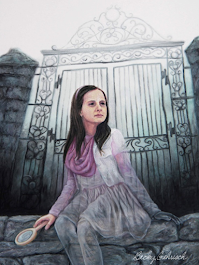
My mind was full of the images that inspired me to create my own magical scenes. In 2019 I drew a ghostly girl and did not connect the association somehow to the cover of Half Magic! The cover art is a part of my subconscious it seems!

What was your most unusual or funny experience as an author/illustrator?

What a great question! At an elementary school visit I asked what tools might be needed to make a picture book. One answer was interesting. The boy said, “a saw!” I wasn’t sure how to respond to that one, so I just said, “Sure, cutting large stacks of paper needs a sharp cutter almost like a saw!” Kids say the funniest things.

I have found that kids love coming up to my 18” mouse puppet, Norman. They want to hug him and pet him. This is more sweet than funny, but I enjoy those moments with young readers. It is amusing when kids want my autograph – in pencil – on their writing notebooks.

What work do you wish you had written and illustrated?

Anything illustrated by David Wiesner or created by Dan Santat – just wow! They have been extremely inspirational to me in my art and illustrations. The dynamic way they lay out their illustrations is amazing.

What is one piece of advice you would give to author/illustrators?

I love the advice to be cautious of taking too much advice. However, there is one piece of advice that I feel strongly about - study your craft. If your craft is writing and illustrating, take serious time to hone each. This will make a world of difference in submitting your work and in the end, selling it!


*Short and Sweet:

Pantser or Plotter? Both! Mostly pantser!

Guilty Food Pleasure? Ice cream!

Favorite Hobby? Painting and light hiking.

Dog or Cat Person? Cat currently. Maybe all those years of mischievous dogs wore me down!

Who would you like to have dinner with (living or dead)? David Wiesner. His illustrations are amazing, and I would love to know more about how his brain works.

Do you do your best work in the morning, afternoon, or evening? Evening. If I could, I’d work from 12pm-4pm and 8pm-12am.


   Since Bookling Media’s start in 2020, Becky has built and led the team through the publication of their premiere title and is now announcing national distribution! Bookling Media has also opened submissions for author-illustrators to submit their manuscripts for publication.

Check out the submission guidelines here: https://www.booklingmedia.com/submissions


A Few of My Favorite Picture Books

By Gloria Reichert

If you are a picture book writer, you know how important it is to keep up with books that have been recently published. These books let us know what topics are current and provide inspiration in many ways. Several picture books have caught my attention because of their messages and/or illustrations.  Even though my list could go on and on, this short list of creative books provides some wonderful mentor texts for writers to consider.

Giraffe Problems by Jory John, illustrated by Lane Smith

“I feel bad about my neck. I do. I can’t hide it,” says Edward, the giraffe. He lists the reasons his neck gives him problems and also the ways he has tried to camouflage his neck. He envies other animals’ necks - until he meets Cyrus, the Turtle. The wonderfully creative illustrations and page folds further enhance the text and add to the enjoyment of the book. This companion book to Penguin Problems by the same team presents some important thoughts for all to consider.

Thank You, Omu, written and illustrated by Oge Mora

In this heartwarming tale, Omu looks forward to enjoying the pot of stew she is cooking for her evening meal. Its scrumptious smell drifts through the neighborhood. Drawn by the delicious scent, folks from the neighborhood knock on her door all day long. What should Omu do? Should she share with all these people? What will she have for dinner when her stew is gone? The ending is this 2019 Caldecott Honor Book is wonderful, and the fantastic cut paper designs supplement the text beautifully. I personally could read this book over and over. 

My Heart, written and illustrated by Corinne Luyken


    “My heart is a window.
      My heart is a slide.
      My heart can be closed
     or opened up wide.”

The sparse lyrical text and exquisite illustrations guide the reader to an important theme: our hearts can guide us through all that befalls us if we listen to it. This book contains many messages about love and acceptance and should be required reading for everyone.

The next two books caught my attention because of the unique main characters – a rotten potato and a brick! They teach us that literally anything can become the main character in a story.

Rot, The Cutest in the World, written and illustrated by Ben Clanton


Rot, an adorable mutant potato, loves competitions and decides to enter a “Cutest in the World Contest.” He is certain he will win – until he sees the other contestants. Rot tries different things until he decides to just be himself.

Brick, Who Found Herself in Architecture, written by Joshua Dean Stein, illustrated by Julia Rothman

When Brick is a baby, she wonders what she might become and sets off on a journey to find her place in the world. She visits well-known brick structures around the world. The interesting back matter focuses on the architecture used in the book.

Hello, Lighthouse, written and illustrated by Sophie Blackall

This 2019 Caldecott winner showcases the gorgeous integration of text and illustration and serves as an outstanding mentor text. It transforms facts about lighthouses into a lyrical story about a lighthouse and its last keeper. This book is an excellent example of “showing,” not “telling.”

Hopefully, some of these books will inspire you and lead you to success in your own creative endeavors.

Interview with author Toni Buzzeo

By Laurie Knowlton

I'd like to introduce a new friend, Toni Buzzeo. I met Toni while in Florida. Prior to meeting Toni I'd read a preview of When Sue Met Sue, published by Abrams Books for Young Readers. The article caught my attention because of my love of fossils.

Not long afterwards I met Toni. When I entered her home I saw her author copy of new book sitting on her coffee table. I picked it up immediately, recognizing it. “I know this book!” I said. “I read about it!"

We quickly became friends, talking about writing, publishing, a love of fossils! After enjoying our time together, I knew our readers would love to get to know Toni also.

Biography

New York Times bestselling children’s author Toni Buzzeo has published 27 picture books for kids as well as 11 books for teachers and librarians. Toni and her books have won many awards, including a 2013 Caldecott Honor for One Cool Friend, illustrated by David Small. She writes for a broad audience, from the very youngest readers through elementary-aged children. Her characters are sometimes real and sometimes fictional, sometimes human and sometimes animals whose experiences echo those of a human child. No matter what, her characters are as lovable as the children Toni writes for. Before publishing for children, Toni was a Maine elementary school librarian and college and high school writing teacher. Now she lives and writes full time from her charming writing cottage in Arlington, Massachusetts. For lots more information, visit www.tonibuzzeo.com.

What inspired you to write When Sue Found Sue: Sue Hendrickson Discovers Her T. Rex?

After I published A Passion for Elephants: The Real Life Adventure of Field Scientist Cynthia Moss (Dial, 2015), I knew that I had found a publishing niche I wanted to continue to occupy—telling the stories of inspiring women scientists in illustrated picture book biographies. So, I put out a call to my school librarian community on the LM_NET listserv and asked for suggestions. When someone mentioned Sue Hendrickson, I dug into preliminary research and loved what I found—that she was yet another self-taught scientist, like Cynthia Moss, another woman so strong and independent that she devoted her life to the work she trained herself for, in Sue’s case, a life of discovery. A major event of that life of discovery was her encounter, in 1990, with the largest and most complete Tyrannosaurus rex skeleton ever uncovered. Not only did she use her skills and knowledge as a paleontologist, Sue also trusted her intuition—the entirely internal sense that the cliff, seven miles away, was calling to her, as indeed, it was!

You have two very different books about dinosaurs: No T. Rex in the Library and When Sue Found Sue: Sue Hendrickson Discovers Her T. Rex. Can you share some insight on the similarities and differences in writing these two books?

Would it do to just say that they are completely different in every way? That is almost true, actually. While No T. Rex in the Library (Simon & Schuster, 2008) is fiction with a young character who misbehaves in the library and brings a T. rex to life from a book, thus causing ensuing impossible events such as a broken aquarium and knights doing synchronized swimming in the spilled pool of water, When Sue Found Sue (Abrams, 2019) is nonfiction, featuring the accurate story of Sue Hendrickson’s life, from her shy and lonely childhood to her astonishing and unlikely discovery of the largest T. rex skeleton ever uncovered.

However, it is true that a single author—me!—wrote both of these books. And that author is not even a huge dinosaur-nerd. While I think dinos are cool, and I am curious about them, they aren’t the thing I am most passionate about. Actually, the thing I am most passionate about is writing.

I noticed you have several series books. How is writing a series different that a single title?

The answer is different depending on the genre. For the fiction books I have written in series, the Dawdle Duckling (Dial) and Adventure Annie (Dial) books, there are several advantages. First, as the fiction author, you already know your character and how he or she will react to the situations you put her or him into. And, to some extent, you know the secondary characters. You may even know the setting. The challenge in that can be to come up with unexpected plot twists that challenge the well-known character.

For nonfiction, such as my Whose? (Abrams Appleseed) series, what you have at the outset is a predictable format. For each of these board books, for instance, I know that I will be focusing on six professions and that the professions will be revealed through a guessing game which will require the young reader to identify the tools or vehicle that the professional uses to accomplish her or his work. Beyond that and the requirements of a rhyming text following a prescribed pattern, the content is entirely unique.

What is the most exciting event you had as a writer researching for a book?

My first published book, The Sea Chest (Dial, 2002) in which a ship’s captain and his wife cast their baby upon the ocean waves in a sea chest to save her life, was based on a legend from mid-Coast Maine—a legend that many Mainers believed to be true. As a certified librarian, it was important to me to get to the bottom of the mystery and determine whether I was writing a fiction or nonfiction book! I was delighted when I met Barbara Skinner Rumsey, former director of the Boothbay (Maine) Regional Historical Society who was able to share with me her work in trying to answer that very question. She had done extensive research that included reading page-by-page and word-by-word the lighthouse keeper’s log books from the decade in which the shipwreck was said to have occurred. Barbara found no record of such a storm, no record of a lost ship, and no record of a baby washing ashore on that lighthouse island. My question was answered, and I got to share vicariously in Barbara’s search!

What was your favorite book as a child?

My favorite books as a child were any of the Beverly Cleary books then in print, including Beezus and Ramona, all of the Henry books, and especially Ellen Tebbets.

What do you like to read now?

I read all genres of children’s books, picture books, middle grade, graphic novels, young adult, and nonfiction. But I also love adult literary fiction, memoir, and the occasional inspirational/lifestyle/philosophy book.

What advice do you have for new writers?

My strongest advice is to take yourself seriously as a writer. In order to do that, you need to join our professional organization, SCBWI (scbwi.org), take as many classes as are available to you and which apply to your work—both locally and online—and attend writing conferences regularly. You also will want to find a critique group (SCBWI can help with that too) and use your membership in that group to learn as much as you can about the revision process and the importance of revising work over and over as you peel away each layer of the onion.

What do you do when you aren’t writing?

I love to read. One guilty pleasure is to get up in the morning, make a cup of coffee and, if it’s warm enough, sit out on the back porch (or during my Sarasota, Florida winters, on the lanai) with the sun shining in and read whatever book I’m immersed in until the coffee is gone. If it’s cold here in Arlington, Massachusetts (early spring/late fall), I prop myself up in bed with the mattress warmer on and drink that same cup of coffee while I read. Guiltiest pleasure of all? A second cup of coffee and more chapters. That hardly ever happens though. I’m too much of a first-child rule-follower, even when the rules are my own!

I also love to work with fiber and fabric as my alternate creative outlet, and I spend time every day playing with each of my young grandchildren.

What is the best investment you’ve made in your writing career financially or time wise?

I’ve invested both time and money in attending conferences and workshops all over the country. They’ve given me new knowledge and often new opportunities. There’s no discounting how much there is to learn at every stage of one’s career.

What author do you wish you could sit and have a conversation with?

See my answer to my favorite book as a child. I would love the opportunity to sit down with 103-year-old Beverly Cleary and ask her about how she weathered such a long and successful career and what advice she’d have for someone like me, with 27 books in print and two more under contract.

Short and Sweet

Panster or plotter?
Guilty Food Pleasure? Cake with lots of frosting
Dog or cat person?
Best time to work? Mid-morning or late at night


Meet Children’s Book Illustrator Ken Min


By Gloria Adams

Ken is an illustrator and animation storyboard artist for commercials and animated TV shows. His picture book debut, Hot, Hot Roti for Dada-Ji received the picture book honor for Literature from the Asian Pacific American Librarians Association (APALA). His illustration work has been recognized numerous times by the Society of Children’s Book Writers and Illustrators (SCBWI) and the Society of Illustrators Los Angeles (SILA). Other books Ken has illustrated include Ah-Choo! by Lana Wayne Koehler and Gloria G. Adams, What Does It Mean To Be an Entrepreneur? by Rana DiOrio and Emma D. Dryden, Love is Love by Michael Genhart, and Benji, the Bad Day, and Me by Sally J.Pla. Ken makes his home in Burbank, California.


What inspired you to illustrate picture books?

I used to work in book stores early on. The children’s section was the one area no one wanted to have to clean up or straighten at the end of the day because it was always a mess and chaotic. Note to readers and parents: Please be sure to pick up after yourself or child when visiting the book store. It’s only polite. One time, it was my turn and while cleaning up, I really started to take notice of all the different books we had. Just really noticing the breadth and variety of art styles. At this time, I had probably just graduated from art school and was looking to see where I fit in, in regard to the art world. This was definitely one area that caught my interest. Of course, it took another 10 years before I really got serious about it, but that’s another story.

Who are some authors and illustrators that you admire?

There are so many. But as far as who influenced my artistic style- it would have to be Ezra Jack Keats, Eric Carle and the Provensens, Alice & Martin. I just admired their clean lines and shapes as well as their sense of color. Someone more recent would be Jon Klassen, Annette Marnat and Christian Robinson.

What’s your favorite medium in which to create?

If you had asked me maybe 3 years ago, I would probably have said that I like to sketch with a pencil (blue), paper and an eraser. But now I really enjoy working digitally. (the ‘undo’ button really eases my anxiety and stress level) And with the variety of digital brush line styles, I can mimic line qualities that really please me.

What’s on your bucket list for your career as an illustrator?

Still trying to crack the “author” part of author/illustrator.

If you weren’t an artist, what else would you like to do for a living?

My mother used to tell me that when I was little, I was crazy about dinosaurs and that I wanted to be a dinosaur doctor. (not that dinosaurs have much use for doctors nowadays.)

What kinds of books do you like to read?


In general, mostly works of fiction. (my favorite book is “The Great Gatsby”). But I also read art books (for the pictures), comics (both books and strips), and I get recommendations of MG and YA books from friends to read.

What book or book illustrator has influenced you the most?

I’m assuming you are referring to children’s literature (for the record, my favorite book is The Great Gatsby. Did I mention that already?? :P) I do admire the whimsy of the Pooh books, and when I try to write, I like to read certain books to get my mind in the right head space. So books like Extra Yarn and City Dog, Country Frog often help me find my voice. 

Who would you like to have dinner with (living or dead)?

Can I say Fitzgerald?!? (do you sense a pattern?!?) Makes one wonder what kind of children’s book Scott would have written if he put his mind to it…and a dinner with him probably would not involve much food, just drinks. Lots of it!

Thinking about children’s book authors, I might say Ezra Jack Keats. He is a huge inspiration on my art styling and it would be nice to talk to him about his work and to thank him. Also, I’m very fortunate to live in an area with lots of fellow illustrators and authors around, so now and then we will get together for a bite. And those are such enjoyable and lively times.

What did you do when you worked at Nickelodeon?

I worked as a storyboard artist at Nickelodeon and more recently at Warner Bros in TV animation. Storyboarding is visualizing your movie/TV show/game before you roll the camera or begin animation. It's part of the pre-production process. As with writing, you might fashion an outline first so you know the steps you will take in your story.

It's the same with storyboarding. Think of it as drawing out a comic (book) to "see" where the events of your story take place, where the action is directed, who is in the shot, how the story progresses in an orderly fashion. It's also where you can try different shots & set ups and determine the best course of action for your story before you commit a lot of your resources to the finished product.


What is one piece of advice that you would give to new/aspiring illustrators?


 Work at your craft and be patient. It will happen if you give it time.


Short and Sweet:

Pantser or Plotter? Definitely a plotter.

Guilty Food Pleasure?  I’m definitely a PIE guy.

Favorite Hobby? Who has time for hobbies with stuff to draw! Ha ha 

Dog or Cat person? meow

Do you do your best work in the Morning, Afternoon, or Evening? Late mornings, for sure, I’m at my “freshest”. Then I roll into the afternoons and probably lose steam by the evening. I guess I have that “business person” work ethic. I’m not necessarily a ‘nite owl’ or a vampire. Not that there is anything wrong with that. Most of my friends do their best work in the wee hours.


When You’re Not the Expert: How Picture Book Writers Can Tackle Topics and Places Outside their Realm


Today, we're excited to share a guest post by author Emma Smith, author of the forthcoming To Live on an Island and other titles. Welcome, Emma!  - Lisa Amstutz


By Emma Smith

Many of us have heard the advice that we should write about what we know. When querying, we’re urged to show that we are the best person to tackle this topic. What, then, made me qualified to write a picture book about a place I had barely heard of, never mind visited, till a few years ago? Going into this project, I felt my own sort of imposter syndrome.

I first read about Washington State’s beautiful San Juan Islands while researching a historical nonfiction picture book set in the same area. I’d always had  a thing for islands and had visited many, from Monhegan and Mackinac to Skye and Corsica. The San Juans sounded as magical as any place I’d ever seen. I was enchanted. And I wanted to write a book describing what it was like to grow up there.

Despite the fact that I had never been to these islands (something I would soon remedy), deep inside, I believed I could write this book. My expertise came from my fascination with and growing affection for the place. Furthermore, later, as I traveled the Islands, I realized that my outsider perspective actually helped me see things locals took for granted. For example, I was struck by the frequent hum of tiny airplanes overhead—something residents don’t even notice anymore. Many people get around by small plane there. I knew I had to put that in the book.

But I wanted to be sure I would get things right. One bookseller gently expressed trepidation, explaining that non-local writers who set books in the San Juans often completely over-romanticize them. I get it. I live in San Francisco, a city so burdened by clichés that it’s hard to know what’s real. I worked hard to capture the magic and charm of the Islands without relying on fantasy and stereotype. I hope I succeeded!


If you want to write about a place (or person) you have limited personal connection to, here are three things you can do to make sure your book rings true:

•    Visit the location. The internet is pretty darn good, but still, there is no substitute for experiencing the sounds, smells, and sights in person. Sit in a café and eavesdrop. Shop at the supermarkets. Catch a flick at the local movie theater. I spent an unforgettable week on the Islands, trying to live like a local, not a tourist.

•    Interview locals. I am shy and an introvert, but I forced myself to meet people. Most helpfully, I had coffee with two Island moms. I asked them questions and, even though I felt silly doing it, I literally read them my rough manuscript, asking them to fact-check and comment on each section. They shared anecdotes I would never have gotten anywhere else, and some of them made it into the book. I also introduced myself to all the booksellers, and each one was kind and supportive. (That’s not really surprising, because booksellers in general are awesome!) These personal interviews made me feel connected to the Islands in a meaningful way.

•    Be humble. Don’t pretend to be the expert. Ask questions. Be honest about the fact that you are an outsider but that you want to do the place justice. I introduced myself to the owner of the general store on one small island, explaining that I was a complete newbie to the area. She was so enthusiastic that she actually made me borrow her car to drive around the island to experience it better! (I had ferried over on foot.)

My next three books are closer to home. Coming up, I have picture books about a dog who survived the 2017 Northern California fires (which also affected my family and friends), the white alligator at the California Academy of Sciences (which I’ve been visiting since I was a child), and Alcatraz (another island—but this time right here in San Francisco!). With these subjects, my hometown advantage made me feel, from the get-go, somewhat more confident and qualified (not that I claim to be an expert on them). But now I’ve learned that writers can also take on topics that hail from far outside their realm, if they do so with integrity, respect, and care.

Emma’s next few books will be published by Sasquatch, Boyds Mills Press, Charlesbridge, and West Margin Press. Her first book, Journey: Based on the True Story of OR7, the Most Famous Wolf in the West, won Bank Street’s Cook Prize and the Sigurd Olson Nature Writing Award. To Live on an Island comes in May 2019 from Sasquatch/Little Bigfoot. Visit Emma online at emmabsmith.com.


Twitter: @emmablandsmith
Facebook: Emma Bland Smith
Instagram: emmasmithsf
 

An Interview with Author LeeAnn Blankenship


By Gloria G. Adams


LeeAnn Blankenship has always loved writing. Her picture book, Mr. Tuggle’s Troubles, was

published in 2005 and continues to be a favorite read-aloud at schools and libraries. She has written for several children’s magazines, as well as educational non-fiction for Rosen and Enslow Publishing. Read on to learn more about LeeAnn's path to publication!


GA: What started you on the path to writing?

LB:  I believe my desire to write is deeply rooted in my love of reading. I was read to quite a bit before I learned to read for myself. My love of reading has never lessened. I also always loved poetry and some of the earliest books I remember from my childhood were written in rhyme. Most of my earliest writing was poetry - when I was as young as seven or eight.

When I was about 10 or 11, my poem “Candyland” was rejected by Ladies Home Journal. I had no idea how to properly submit a poem for publication and had no one in the family to help me. Actually, now I know it was not at all like what the magazine published and it obviously had been written by a child.

I enjoyed English as a subject and especially doing term papers. Poetry seemed to find its way into my class work any time it could. And I remember winning some sort of contest in high school by answering essay questions about the UN and world peace. As a result, my social studies teacher and I went to a banquet or award ceremony at Western Kentucky University.

For most of my working years, I was a social worker with children and their families. I don’t believe I ever consciously thought, “Maybe someday I’ll be a writer.”  I just always loved reading and writing. When I went to college, I majored in elementary education because I loved children. Any time I could take elective classes, I chose something connected with English. When I picked my own topic for research in a senior seminar, I choose “How to Use Poetry in the Classroom.” And I also took a summer course in college about Children’s Literature – and loved it.

I imagine one of the first things I did as a young adult that put me on the path to thinking more seriously about writing was subscribing to Writer’s Digest magazine. I read articles about writing but never really imagined I’d actively pursue that career. And I always noticed those advertisements that said, “Do you want to write for children?”  By then, I had married and started a family. I loved reading to my own children and the transition to thinking about writing for children myself happened naturally I suppose.  


GA: What were some of the challenges you faced on the road to publication?

 LB: My first picture book was rejected five or six times and has never been published. I wrote it in 1973 while my newborn son napped each afternoon. I really knew nothing about what I was doing but tried any way. I suppose I just tried to model my book after others I had read.

So, my biggest challenge at first was my lack of knowledge about the nuts and bolts of writing and publishing. I did get a book out of the library about writing for children and that was a big step – just educating myself about the subject. Then I found a writer’s group that met at the Cuyahoga Falls, Ohio, library. Fortunately, there were two other young women who were interested in writing specifically for children.  Sometimes the three of us would separate from the others and talk about stories, rebuses, and books. When I heard about a one-day workshop for children’s writers, I signed up. There I learned about the Society of Children’s Writers & Illustrators and that a local chapter was in the process of organizing and I became involved.

Not having a strong network of other writers early on was another challenge I faced.

When my youngest child was in high school, I turned 50 years old and realized if I was ever really going to try my hand at writing, I’d better not wait much longer.

Another challenge was the way my life and responsibilities distracted me for so many years. By then, my desire to write had really increased and I just couldn’t ignore it any longer. At that point, I decided to take the Institute of Children’s Literature Course in Writing for children and young people.  (They were the “Do you want to write for Children?” folks). That was where I had my first experiences with actual assignments and learning the craft, as well as dealing with editing comments from my instructor.  It was a valuable course and I began to get more serious about writing and submitting.

I began to submit magazine articles but got discouraged by rejection. I was about ready to give up when I was invited to Ohio State to hear a dinner speech by Wilma Mankiller, the first female chief of the Cherokee Tribe. Before attending the event, I read her autobiography. It focused on her endurance and fighting against the odds.  After her speech, I met her and told her I was a children’s writer interested in writing about her.  She agreed to vet the article for me and “Wilma Mankiller: Proud Cherokee” became my first published piece, appearing in Cricket magazine.

Chief Mankiller and her story played a pivotal role in my not giving up. Rejection is hard on all of us, and her tenacity inspired me to keep trying. 


GA: How did you come up with the idea for Mr. Tuggle’s Troubles?


LB: Mr. Tuggle’s Troubles is a humorous picture book about a childlike guy who is extremely disorganized and the problems that arise because of it.  At the time I wrote it, I was trying to get better organized at home – specifically in my home office. (I am still working on that.)

I actually dreamed the first part of the book and woke myself up laughing.  I got out of bed and wrote down what I remembered. I finished the first draft the following day.  But it was still a lot of revisions plus 7 years and 21 rejections before it was accepted for publication.


GA: What is your writing routine?


LB: I have found I am not a person who can successfully grab a little time here and a little time there. I need larger blocks of writing time. For a while I did well, planning my writing on Wednesdays, Thursdays, and Fridays but recently I’ve been struggling with distractions and the many pressures of life.  So now I’m trying to get back on track.  I write all day on Friday and hope to work up to another day or so on top of that. To be accountable, I recently began reporting in once a week with a favorite editor/friend about how I did each week. I don’t want her to be disappointed in me so it has been an effective incentive so far!


GA: What have been the pros and cons of being a writer?


LB: I’d say the biggest advantage is the joy of creation and the satisfaction of seeing my work in print.  But following close behind is the circle of wonderful writer friends I’ve made (from all over the country) and the fabulous adventures I’ve had as a result of my writing. I’ve met famous people and traveled to fascinating places. Plus, writing means I am always learning.

The cons are that it takes away from time with my family and it still has emotional ups and downs.


GA: What do you do in your free time?

LB: I’m still an avid reader and love gardening, sewing, & being with my family. I used to paint but decided to focus on my writing instead.


GA: Who are some authors in your genre that inspire you?

LB: I grew up with Milne’s Winnie the Pooh books & loved them! But I also like Katherine Patterson, Lois Lowry, Richard Peck, and Shelley Pearsall.

For non-fiction, I admire James Cross Giblin, Larry Dane Brimner, and Candace Fleming. And I can’t leave out the poets! Two of my favorites growing up were Robert Frost and Robert Louis Stevenson. More contemporary poets I enjoy are Shel Silverstein, Eileen Spinelli, and Rebecca Kai Dotlich.


GA: Do you have a favorite children’s book?

LB: Corduroy by Don Freeman.


GA: What are you working on now?

LB: I am currently writing a book for an educational publisher about 21st Century Tunnels.  As soon as that’s finished, I’ll be going back to a middle-grade historical fiction novel I’ve begun about Henry Samson, an English teenage who came to the New World with his aunt and uncle on the Mayflower.


GA: What has been one of your most rewarding experiences as an author?
Sculpture in the eye of a needle by Willard Wigan


LB: In 2009, I was able to spend an entire afternoon with the English micro-sculptor Willard Wigan, who carves the smallest artwork in the world. We were at the Chicago gallery where his sculptures were on display. After my interview for an article that later was published in Highlights for Children, he invited me to join him, his press agent, and the gallery owner for a special lunch. He is such a talented artist and absolutely one of the kindest people I’ve ever met. 


GA: What nuggets of wisdom can you impart to aspiring writers?

LB: If you’ve been bitten by the “I wanna write” bug, you might as well accept it.  Once bitten, you’ll never be the same again!  Enjoy the ride, even the bumpy parts of the road.