Showing posts with label children's books. Show all posts

Introducing Nikki Grimes


By Lana Koehler

I first started following Nikki Grimes from an author post that led me to her Facebook page. Her observations of nature and humanity frequently leave me awestruck.

 One thing that I admire is how she is able to weave words into a tapestry of rhythms and sounds to create her masterpieces. Her poetry is sublime.

 Nikki has graciously agreed to take time out of her busy schedule to answer a few questions that I always wanted to ask her.  

When did you first start writing and why?

I began writing when I was six years old. Initially, I wrote from a need for mental and emotional release.  As I got older, it became more than that.

  How has publishing changed since you first started writing?

I've been in this business, professionally, for more than 45 years.  In that time, publishing has changed in every way.  In the children's book sector, instead of being driven and shaped by English lit grads, it is driven by MBAs; instead of being predominantly backlist, it is more front list with less dependence on school and library marketing.  Finally, the market is marginally more diverse, but still has a very, very long way to go, on that score.

 Who is your target audience? Has that changed over the years?

I don't have a single target audience.  My catalog is quite broad, including picture books, chapter books, middle grade, young adult, and adult.  It hasn't so much changed as grown, over the years. The particular story I'm writing determines the age-appropriate audience.

Who are your favorite authors? 

My list of favorite authors is too long, too broad, too deep to mention.  That said, I will name three who have influenced me most deeply: James Baldwin, Virginia Hamilton, and Katherine Paterson.

 What is the book you’re most proud to have written?

I am most proud of Ordinary Hazards, my memoir.  I worked on it, off and on, for 39 years, and it was easily the most challenging work I have ever attempted.

  Do you ever collaborate when you write? Who might you like to collaborate with? 

I've collaborated once, with Stacy Wells, on Stronger Than, a book with Heartdrum slated for 2025.  I look forward to doing so, again.  I have a couple of other possible collaborators in mind, but I won't name them.  Let it be a wonderful surprise!

  Do you have a favorite book that you’ve written or read? 

Two recent favorite reads: Why Fathers Cry At Night, by Kwame Alexander, and Kin, by Carole Boston Weatherford—both are memoirs, my favorite genre to read.

  Anything else you’d like to say?

If you care about democracy, if you care about our future, if you care about our children, join the fight for children's right to read diversely.  


 Quickie Favorites:

Color: Cobalt blue

Flower: Rose

Food: Gelato

Time of year: In general, Spring.  For travel, Fall.

Saying or quote: Something my grandmother used to say: Use your head for something other than a hat-rack.


Keep in touch with Nikki:

Facebook: Nikki Grimes

Instagram: @poetrynikki

X: @nikkigrimes9

NikkiGrimes.com


Meet Becky Gehrisch, owner of Bookling Media

 by Gloria Reichert


   Becky Gehrisch     

       After meeting Becky Gehrisch at the recent SCBWI: Ohio North Conference, I was fascinated that she has established a publishing company called Bookling Media. I had all sorts of questions about how one goes about doing such a thing and thought readers of this blog might also find such information useful, especially those who are authors/illustrators. Becky graciously agreed to be  interviewed. I hope you enjoy meeting her and learning about her company.

       Becky is the Creative Director at Bookling Media LLC, an independent press redefining the kidlit publishing industry, book by book! Bookling Media focuses on picture books created by author-illustrators. Passionate about art, Becky has an art degree from The Ohio State University and has served as the Illustrator Coordinator for the Central and Southern Ohio chapter of the Society of Children’s Book Writers and Illustrators.
   

 Becky, what inspired you to write and illustrate your first book?

As a kid, I loved seek-in-find aspects to illustrations and details in picture books. When I was in middle school, my art class had an opportunity to submit a picture book through a nationwide Written and Illustrated program. I won Honorable Mention! The thrill of creating a physical book to call my own was satisfying. My name was on a book –how cool is that?!

I then went to The Ohio State University to study painting and drawing. I was drawn (pun intended) to Norman Rockwell and other illustrators. I loved art that told a playful, childlike story. After graduating, I took time away from the fine arts and relocated to the countryside. There, I was newly inspired to pick up my paintbrush and make a fun illustration of three dogs playing in a bathtub!

At OSU, I almost minored in Art History. Remembering dates and names was a challenge but I was intrigued by how art changed throughout time. Because of this, I included fun art facts about art styles in the back material of Escape to Play. Creating classic art on the pages for kids to find and then read about later was a blast! I loved the interactive aspect this is for kids.


I absolutely needed, in my core, to create a fun book that allowed kids to enjoy detailed illustrations! I loved the process of creating each chaotic scene for the dogs to explore which then evolved into a story. Adding the easy-to-read poem tied everything together.

Who are some author/illustrators you admire?

Wow! So many. Here are some in no particular order: Wanda Gág, Jan Brett, Dan Santat, Brian Lies, Brendan Wenzel, Peter Brown, Ryan T. Higgins, and many others! They all have such a unique and mastered illustrative style. The reason their books stand out to me is because of their storytelling power through the marriage of the words and images. I often love the humorously written ones best but a beautiful, touching story is quite captivating, too!

What led you to found Bookling Media? How will it be different from other publishers?

I saw a need in the industry to create Bookling Media through my own experiences as an author-illustrator and through my involvement with SCBWI. I realized how terrible the traditional publishing experience has been for many creators, not just when submitting manuscripts to publishers, but also after their books were published.

I saw friends powerless to market their books and take control of their own success due to their publishers’ policies and contract restrictions. I knew there had to be a better way. So, a plan emerged! I wanted to create a new kind of publishing company that is known for high-quality picture books while also respecting the creators and allowing author-illustrators to remain in control of their intellectual property rights.

What will you do if you receive a manuscript that is beautifully illustrated but poorly written? Or, vice versa?

I feel that a manuscript with great illustrations but poorly written is easier to adjust and mold into a polished piece. We can always develop a story. It would be harder to keep the essence of

the art in a collaboration with another illustrator. If the meat of the story is unique, the rest can follow.

If a manuscript is written well but the creator lacks in artistic skill, it will be hard to move forward. I strive for high quality, especially in the illustrations, and a picture book should reflect that. I have already received some manuscripts which have great illustrations, so I’m confident that the next book that Bookling Media releases will be beautiful!

Can you share some details about your Bookling Media? How will you promote and distribute your books? Do authors receive royalties? Will you use freelance or in-house editors? etc.

There is a lot to cover here! Relationships are everything, and that is the value that Bookling Media brings to the table for our creators. My team consists of industry professionals that either have their own businesses or freelance. It works well because we can get experienced professionals such as editors, designers, proofreaders, and typesetters to work on our projects on a fractional basis. We use offset printing instead of print-on-demand to give us the highest degree of creative control and quality.

When the book is ready, we run a presale campaign to help cover the initial costs of publication and printing. Working closely with the creator, we put together a launch team and marketing plan for the presale. Our relationship with our distributor lets us make our titles available through Baker & Taylor for libraries, Ingram for independent bookstores, Barnes &Noble, Amazon, and even Walmart.com to name a few.

We provide marketing support to drive sales, and our creators make a percentage of every book that Bookling Media sells, either directly or through distribution. Unfortunately, the middlemen and retailers take a large cut. Where our creators can make the most money is author events and school visits.

We have built a toolkit to help creators market themselves and host successful events. We make copies of their book available to them at deeply discounted prices so that they can sell directly at their events or on their own website. Our authors enjoy access to our marketing coaching and materials, as well as the freedom to sell and market their books as they see fit.

What kind of books do you like to read?

This is the toughest question! I love a variety of genres, but I really enjoy picture books and a good, historical fiction!

What book has influenced you the most?

I received a chapter book, Half Magic, from my aunt when I was a kid. It was by Edward Eager and originally published in 1954. This was the first book that I could read with minimal illustrations, and it struck a chord in me. Merging the magical and every-day of four children, was intriguing.


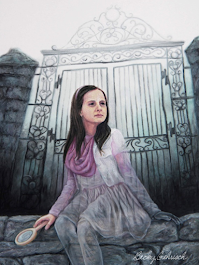
My mind was full of the images that inspired me to create my own magical scenes. In 2019 I drew a ghostly girl and did not connect the association somehow to the cover of Half Magic! The cover art is a part of my subconscious it seems!

What was your most unusual or funny experience as an author/illustrator?

What a great question! At an elementary school visit I asked what tools might be needed to make a picture book. One answer was interesting. The boy said, “a saw!” I wasn’t sure how to respond to that one, so I just said, “Sure, cutting large stacks of paper needs a sharp cutter almost like a saw!” Kids say the funniest things.

I have found that kids love coming up to my 18” mouse puppet, Norman. They want to hug him and pet him. This is more sweet than funny, but I enjoy those moments with young readers. It is amusing when kids want my autograph – in pencil – on their writing notebooks.

What work do you wish you had written and illustrated?

Anything illustrated by David Wiesner or created by Dan Santat – just wow! They have been extremely inspirational to me in my art and illustrations. The dynamic way they lay out their illustrations is amazing.

What is one piece of advice you would give to author/illustrators?

I love the advice to be cautious of taking too much advice. However, there is one piece of advice that I feel strongly about - study your craft. If your craft is writing and illustrating, take serious time to hone each. This will make a world of difference in submitting your work and in the end, selling it!


*Short and Sweet:

Pantser or Plotter? Both! Mostly pantser!

Guilty Food Pleasure? Ice cream!

Favorite Hobby? Painting and light hiking.

Dog or Cat Person? Cat currently. Maybe all those years of mischievous dogs wore me down!

Who would you like to have dinner with (living or dead)? David Wiesner. His illustrations are amazing, and I would love to know more about how his brain works.

Do you do your best work in the morning, afternoon, or evening? Evening. If I could, I’d work from 12pm-4pm and 8pm-12am.


   Since Bookling Media’s start in 2020, Becky has built and led the team through the publication of their premiere title and is now announcing national distribution! Bookling Media has also opened submissions for author-illustrators to submit their manuscripts for publication.

Check out the submission guidelines here: https://www.booklingmedia.com/submissions


DON’T JUST END IT!


By

Kate Carroll


            Last month, Six Pen’s author, Laurie Lazarro Knowlton, splashed into spring with seven writing hooks that are sure to capture a reader’s attention. This month I decided to focus on entertaining endings.

            Maybe you’ve already written a perfect masterpiece, but the ending doesn’t measure up. You’re searching for that satisfying stop that will cause readers to reprise, “Again!” Stories that surprise us with a twist at the end, ones that come full circle, or those that drop in one last drip of humor can deliver that marvelous magic for the reader.  Sounds simple enough, but just like all things picture book, penning a winning ending takes practice.

            If story endings challenge you, take some time to study several well-loved picture books and uncover the craft elements that make their endings successful.  Enlist the expertise of a well-read librarian to lead you to some of the best examples.

            Below are endings from both classics and new works that have effective endings and make kids want to read and repeat.  Some employ the use of more than one device that double down on a great pay-off.


Repetition and Dialogue


              … “Oh, bliss!” says the cow, and she jumps right in.

“Oh, bliss!” says the pig with a happy grin.

“Oh, bliss!” says the duck, splashing in with the rest.

“There’s no doubt about it. Home is best!”

Wishy - washy.  Wishy - washy.


Excerpt from ~MRS. WISHY-WASHY’S FARM by Joy Cowley


            Dialogue and Surprise


           … “I think we can!” said Cheese Doodle. 

          “How about you Cookie? Hey, Cookie, where are you?”

          “Umm… Cookie?”


Excerpt from ~SNACK ATTACK! By Terry Border.


      Humor and Surprise


                 … Excuse me, have you seen a rabbit wearing a hat?

No. Why are you asking me? 

I haven’t seen any rabbits anywhere. 

              I would not eat a rabbit. Don’t ask me anymore questions.                          

OK. Thank you anyway.


Excerpt from ~I WANT MY HAT BACK by Jon Klassen


      Circular, Repetition, Dialogue


…A is out of bed, and this is what he said: “Dare double dare, you can’t catch me.

 I’ll beat you to the top of the coconut tree.” Chicka chicka BOOM BOOM!                                                                              


Excerpt from ~CHICKA CHICKA BOOM BOOM by B. Martin and J. Archambault


            Circular and Humor


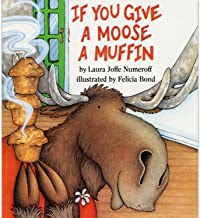
               ...Seeing the blackberries will remind him of her jam. 

              He’ll probably ask for some. And chances are…                       

              if you give him the jam, he’ll want a muffin to go with it.


Excerpt from ~IF YOU GIVE A MOOSE A MUFFIN 

by Laura Numeroff


        Humor and Dialogue


       … “That first day wasn’t so bad,” Dad says, feeling pleased. 

“We can come back tomorrow,” Mom offers. “If you want.”

           “Umm,” Pascaline says with a smile...                                                                                      

“Never, not ever.”


Excerpt from ~NEVER, NOT EVER! by Beatrice Alemagna


Total Surprise


 This three-act, one word picture book has a brilliant ending!


~SPENCER'S NEW PET by Jessie Sima


Seven Spring Hooks

by Laurie Lazzaro Knowlton 


            Spring is so close we can almost taste it!

 The thing I love about spring is that after so many gray days the sun finally warms the earth, and all the world is made anew.

  Spring also seems to be a time when new ideas flood my mind. Ideas are great, but everyone knows it is how you execute that idea that makes a story.  Good stories begin with a great hook. A hook grabs your reader and gets them to sit down and read. But how do you do that?

  I've pulled together seven types of opening sentences that are guaranteed to make the reader want to keep reading.


1.      Start with an exclamation!

 “Hi! I'm the bus driver. Listen, I've got to leave for a little while, so can you watch things for me until I get back? Thanks. Oh, and remember: Don't let the Pigeon drive the bus!”

                                     ~DON'T LET THE PIGEON DRIVE THE BUS! By Mo Willems


2.      Start with a question.

 “Brown Bear, Brown Bear what do you see? I see a ...”

  ~BROWN BEAR, BROWN BEAR WHAT DO YOU SEE?  Bill Martin Jr.


 3.      Start with a statement.

 “Grandma Ronnie isn't home anymore.”

    ~A YOUNG MAN'S DANCE by Laurie Lazzaro Knowlton


4.      Start by showing the setting.

 “In an old house in Paris that was covered in vines lived twelve little girls in two straight lines.”

                         ~ MADELINE, by Ludwig Bemelmans


5.      Start with Onomatopoeia.

 “Hieronymus Bets has unusual pets. Slurp the sugapotomus is his slimiest pet.” 

                          ~HIERONYMUS BETS AND HIS UNUSUAL PETS, by M.P. Robertson


6.      Start with a repeat refrain.


“Before John was a jazz giant, he heard hambones knocking on grandma's pots, Daddy strumming the ukulele, and Mama cranking the phonograph.

   Before John was a jazz giant, he heard steam engines whistling past...”


  ~BEFORE JOHN WAS A JAZZ GIANT, by Carol Boston Weatherford


7.      Start with the main character.

 “Clementine waited until her work in the Big House was done and the twinkle of stars filled the night sky above the Cane River. She was ready to paint.”

             ~ART FROM HER HEART, FOLK ARTIST CLEMENTINE HUNTER, by Kathy Whitehead


         Spend some time in the library reading first lines in picture books to make your own list of great ways to hook a reader, then spring into a new season of writing by hooking your reader with a great opening sentence.


Remembering Richard Peck


by Gloria G. Adams


It’s January again, and my turn to write for our blog. I thought about so many things that you often think about as a writer in January: setting writing goals, taking workshops, attending conferences, making a list of all the books you want to write this year or how you’re going to finish writing that one that tugs the most at your mind and heart strings.


Then I thought a list of inspirational writing quotes might be appropriate. And when I think about inspirational writing quotes, I always think about Richard Peck.


Richard Peck was one of the pioneers of young adult literature, whose books I discovered when I first started working in the library. He won many awards, including the Newbery Award, and the prestigious Margaret A. Edwards award for his “significant and lasting contribution to young adult literature.”

I was fortunate enough to attend a few conferences where I heard him speak. He had piercing blue eyes and a compelling presence that commanded everyone’s attention. I was even lucky enough to meet him and share lunch and conversation with him at a writing festival in which I participated while working as a librarian.

 But even more than his talent as a writer and speaker was his heart for young readers. He had taught English to middle-schoolers before he began his writing career in 1971, where he witnessed first-hand some of the negative consequences of peer pressure. His message resonates through his books: “You only grow up when you’ve walked away from those people. In all my novels, you have to declare your independence from your peers before you can take that first real step toward yourself.”

 When he read us some of the letters he’d received from his readers, you could tell he had touched many lives through his books and really made a difference. He passed away in 2018, but what a legacy he left us!


 We writers all have authors we admire, respect, and by whom we are inspired; the one at the top of my list is Richard Peck.

 Here are some of my favorite Richard Peck quotes:


 “The only way you can write is by the light of the bridges burning behind you.”


“Because nobody but a reader ever became a writer.”


“I'm a writer because I never had a teacher who said, "Write what you know." If I'd been limited to writing what I know, I would have produced one unpublishable haiku. Beatrix Potter was never a rabbit. J. K. Rowling did not attend Hogwarts School.”


“[A young adult novel] ends not with happily ever after, but at a new beginning, with the sense of a lot of life yet to be lived.”


“Learn five new words a day…You want to use words to create new worlds… If you are going to be a writer, you need to collect words.”


“If you cannot find yourself on the page very early in life, you will go looking for yourself in all the wrong places.”


“I read because one life isn't enough, and in the page of a book I can be anybody;

I read because the words that build the story become mine, to build my life;

I read not for happy endings but for new beginnings; I'm just beginning myself, and I wouldn't mind a map;

I read because I have friends who don't, and young though they are, they're beginning to run out of material;

I read because every journey begins at the library, and it's time for me to start packing;

I read because one of these days I'm going to get out of this town, and I'm going to go everywhere and meet everybody, and I want to be ready.”

 ― Richard Peck, from Anonymously Yours


For more information on Richard Peck:

https://www.nypl.org/blog/2018/06/11/life-work-richard-peck-nypl-catalog

https://www.kennedy-center.org/video/education/literary-arts/a-conversation-with-author-richard-peck/


Deep Point of View - Is it For You?


by Gloria G. Adams


As writers, we are often told that one of the most important things, if not the most important thing, is to keep your readers in the story so that they don’t close the book and never finish it.

To do this, we need to craft our story so that the readers relate to our characters.

There are many tools in the writer’s workshop by which to accomplish this: a strong hook, lots of sensory details, great descriptions (one of my favorites is Cynthia Rylant’s lost cat in her Henry and Mudge series who looks like “mashed prunes”), and, of course, “showing, not telling.”

Another tool that is used less frequently but can be quite effective, is Deep Point of View.

 Deep POV is written as if the reader is inside a character’s head. According to author, Lisa Hall-Wilson, “Deep point of view is a style of writing that aims to immerse the reader in the story so they share the character’s emotional journey as though it’s their own.” 

One way to accomplish this is to remove filter words like thought, wondered, saw, knew, realized that remove the reader from the intimacy of deep POV.

Instead of this:

I heard a dog barking in the distance and wondered if it might be Max.

Use DPOV:

A dog barked. Not close, but, could it be Max?

 Here’s another example:

                                                               Without DPOV:

           I think Shelly looks so pretty in the new pink tutu. It makes her look as delicate as a rose petal. But I know she’s not really pretty or delicate. After what she said yesterday, I realized she was as hard and unforgiving as a thorn.

                  With DPOV:

Shelly looks so pretty in the new pink tutu. Delicate. Like a rose. But she’s not pretty or delicate. The real Shelly is hard. Unforgiving. More like a thorn.

 But as much as it can take us inside a character’s head, DPOV can be limiting, and it doesn’t work for every story. Unless you have multiple points of view, or sections of narrative, you can only see everything from inside one person’s head. Even so, it’s fun to try out new writing tools, and, though challenging, practicing writing in Deep Point of View can be a great way to stretch your writing “muscles.”

To see how others use this tool, check out these books that use DPOV:

The Hunger Games by Suzanne Collins

Wish by Barbara O’Connor

See You in the Cosmos by Jack Cheng

ROOM by Emma Donogue

 Learn more about writing in deep point of view from Lisa Hall-Wilson and the Deep Dive Author Club: https://lisahallwilson.com/


Interview by Laurie Knowlton with the author Mayhem 2020

By Laurie Knowlton
 

Well, Mayhem, you have had an astonishing year and you are still rolling. Can you tell us a little about 2020?

Oh yes, 2020 has been some of my finest work. I’ve changed the whole world’s outlook on, well just about everything. I’ve been in the news daily. There are hundreds of blogs, magazine articles, tabloids, tweets, snap chats, Facebook articles and even old fashioned newspapers that haven’t been able to go a day without mentioning Little-ole-Me, Mayhem 2020!


Yes, that is the undeniable truth. Mayhem I'd like to ask you specifically about the publishing world. How have you, Mayhem 2020, changed the world of publishing?
    
A better question is, what haven’t I done to the 2020 publishing world?

First of all, everything gets a little catawampus during an election year. And boy did I enjoy stirring the pot on this year's election, but that is a different story.

Then of course when I unleashed COVID-19, you got to see me, Mayhem 2020, in action! Publishing houses sent their people home to shelter in place, making contacting editors even more difficult. And the books that were in the pipe-line for contracts got put on hold because, well who knows  what else I have up my sleeve. WINK! WINK!   

And if that wasn’t enough books that were ready to be released were either postponed or dropped, just like that! It was a thing of beauty! If I do say so myself.

Then, just to tighten the noose around publishing's throat I closed all the book outlets! No libraries, no book stores, no national book conventions... chuckle...no books...


True, but you didn't stop the libraries, book stores, or conventions. They found a way through online orders from the libraries, online sales, and conferences.

Yeah, well... I still had them running around like chickens being chased by a fox! You should have seen the feathers fly trying to find a way around me! Ha!


Mayhem, I can’t help but notice you're laughing at that! What about all the people who worked so hard on writing, editing, and publishing all those beautiful stories? What about all the book sellers and our kind neighborhood librarians?

Don’t be a marshmallow! It’s me, Mayhem 2020!

Those people need to get a  real job! Something in the demolition field.   


What about dreams? Goals? Seeing God-given creativity come to life on the paper pages of a real book! Don’t people need books?   

Books-smooks! You’re behind the times. Who reads books anymore? I’ve done the world a favor!
    

Well, Mayhem, I need books. I love the smell of a freshly printed book. I love the feel of the pages on my fingers. I love the comfort of wrapping up in a blanket, and sitting in my reading chair. I love getting lost in the lives and events of a new character.   

And what about all the children? How are they going to fall asleep at night without curling up in their Mama or Papa's lap to hear a story?
    
Get out the violins... It’s me, Mayhem 2020, do you really think you can go back to all that after what I’ve accomplished? Things are NEVER going to be the same! I am Mayhem 2020!
   

Mayhem 2020, I think you've forgotten something.

Me? Impossible.
    

Yes, you. You have forgotten that humans have a certain je ne sais quoi, an unbreakable spirit. You might be able to destroy everything around them, but you cannot break their spirit. Writer's need to write. Illustrators need to create. And people need to connect.

The one and only place a person can connect with another person's imagination firsthand is in a book. You may not be able to travel outside your doors because of a pandemic, but you can go anywhere past, present, and future in a book. You can live a life very unlike your own, experience a different culture, live a different reality, all by reading a book.     

Mayhem, you may think that books are dead, but I think you are wrong. We are weathering a great storm of chaos right now, but it can't last forever. Remember after every storm there is a new day.   

The publishing world may look like it is dead, but it is only taking cover. When the sky clears people are going to be hungry for new books, and publishers are going to provide them.    

Wow! Who do you think you are, Pollyanna? You just wait and see!
   

That is exactly what I am going to do. In the meantime I have a book calling my name. You'll find me in my chair reading until Mayhem 2020 is over... by the way it's December and the days are tick-tocking away to a new year and new possibilities!


Six Thoughts About Writing Nonfiction For Kids

By Gloria Reichert

Since I have been immersed in researching and writing a new picture book biography, ideas about writing nonfiction for children have been swirling in my mind. Here are a few for writers in this genre to consider.

1. Ask yourself, “WHY would a kid want to read this?” Try to find some interesting way of connecting to kids. It could be a quirky fact, a delightful detail, or something humorous you discover doing research. Don’t pass up items of this nature. They could be just the hook you need.

2. Make sure your research is flawless. We owe it to our readers to make sure the truth is told. Use primary resources, such as diaries, letters, and newspapers as much as possible. Search for something in the person’s childhood that laid the path to his/her adult accomplishments. Also search for a connection that you personally share with the subject. This will lend both authenticity and heart to your writing.

3. Share the information in creative ways. Few children will be enthralled with a list of facts that reads like an encyclopedia entry. Write in scenes to show what happens and pull your reader into the story. Use a variety of sentences and punctuation. Fill your sentences with figurative language and sensory details. Incorporate word play. Write the story in different ways until you find the best way to tell it.

4. Read and study mentor texts published within the last five years for inspiration. Many of them have taken approaches that model creative ways of sharing information. Examples include No Monkeys, No Chocolate by Melissa Stewart and Allen Young, illustrated by Nicole Wong, Stonewall: A Building, an Uprising, a Revolution by Rob Sanders, illustrated by Jamey Christoph, and Moth: An Evolution Story by Isabel Thomas, illustrated by Daniel Egnéus.

5. Consider ways to use back matter with your project. This supplemental material can provide   the reader with a deeper look into the subject about which you are writing. It can provide background knowledge to enhance the reader’s understanding. It can provide curricular tie-in’s for teachers to use.

6. Use online resources to keep up with the latest about writing nonfiction for kids. Check out the six sites below for tons of helpful information.

https://www.nonfiction-ninjas.com
https://bethandersonwriter.com/blog/
http://celebratescience.blogspot.com                                             
https://www.melissa-stewart.com
https://www.katemessner.com
https://www.nnf.com


Happy researching! Happy writing!