Showing posts with label children's authors. Show all posts

Ten Writing Prompts for 2025


by Gloria G. Adams

To celebrate our tenth year of writing A Song of Six Pens blog, we begin with 10 writing prompts to get your creative ideas flowing for 2025. Have fun!


1. Once upon a time there was a tiny green frog named Thomas. One day he woke up and he was no longer green. He was a brilliant shade of…


2.      As soon as I saw the look on Mama’s face, I knew exactly what had happened.


3.      Make up a story using this picture. Ask these questions:

             Who are they?

             What happened to them?

             Are they related to each other?

             What is the setting?

            What sensory details does the picture conjure up?

            What will happen to them?


4.      Write a story about a world where everything is upside down, except for people.


5.      Make up a story in which a little girl is obsessed with wanting to be an astronaut.


6.      Research an unusual animal, insect, or plant and write a lyrical nonfiction picture book about it.


7.      Write a picture book about things in nature that are black. For a bigger challenge, write it in rhyme.


8.      Make up a story using this picture.


9.  Maggie was the naughtiest dog in the whole neighborhood. She was always getting into trouble. But then, one day…


10  Celia Carolina Crawford counted everything. She counted how many times she brushed her hair. She counted the number of tiles on the kitchen floor. She always counted each of her stuffies every morning.  (Then, something related to counting goes wrong.)

Meet Award-winning Author Rachele Alpine

 By Gloria G. Adams


Rachele, what made you decide to become an author? Please tell us a little bit about your journey to publication.

 I’ve been a writer since before I could talk…well, kind of!  I had a severe speech impediment, and most people couldn’t understand me.  My mom bought me a diary and told me to write down all the things I wanted to say but couldn’t.  Once I started there, I couldn’t stop and have been telling stories my whole life.  While I took writing classes in college and graduate school, it wasn’t until I was about to turn thirty that I made it a goal to finish a book and put myself out there.  It was the push I needed, and I finished my first book, Canary, right before my birthday. It ended up being my debut novel.


I’ve read that you’ve said working as a teacher with teens gives insight into what they care about. Can you tell us more specifically about how those insights inspired ideas for one or more of your books?

 I’ve always loved reading contemporary novels and writing them; it’s what I gravitate toward.  Because I’m surrounded by children all day (and night with my two boys!), it’s the world I know.  I see their struggles, triumphs, things they wonder about, things that worry or scare them, and the things they love.  My mind is always asking “what if” questions and as I live my life around kids who are discovering the world and figuring out who they are, I can’t help but explore the topics that they are, too.  


What was the catalyst for your Invincible Girls Club series?


I wanted to write a book about a group of girls who set out to prove that you can never be too young to change the world.  I have so many young readers, and it has always been important to me to write positive and uplifting books like the type of books I loved when I was a kid.  This series was so much fun because not only did it show the difference anyone can make (young or old!), but it also highlighted real-life invincible girls with biographies at the end of the book, and provided ideas for ways that the reader could do amazing things too.   


Tell us what it was like writing with other authors on Best. Night. Ever.  Would you do it again?

It was a magical experience!  

There were six other writers, and to this day, I’ve only met one of them in person!  It’s kind of wild to think that we could pull off writing a book online, but we did and had a blast during the process!

We wrote on a Google Doc and used a three-week cycle. One week you were creating a new chapter, the next week you were providing feedback for someone else, and the third week you were revising your chapter based on feedback from others.  I would literally go to sleep and wake up the next day to new chapters!  I always said it was like Christmas morning and the new words were the gifts! 

I would totally collaborate with others again; sign me up!


Do you have a favorite character that you’ve created? Or do you have one in your mind that you haven’t written yet?


I’ve always loved Gabby in the book You Throw Like a Girl.  

The book was based on an experience I had, but unlike me, Gabby did all the things I wished I had been brave and strong enough to do. 

I just love her spunk and love for her family.


Can you share a funny or unusual experience as an author?


One of the coolest moments was selling rights for Best. Night. Ever. to Netflix.  They had wanted to do a thirteen-episode series, and it was so cool to see it start to come together.  While it ended up not happening (COVID and other circumstances stalled production), it is still cool to say that my book was optioned by Netflix.  I also found out not long ago that The Invincible Girls Club: Art with Heart sold foreign rights to the Czech Republic.  It’s the only book that I’ve sold foreign rights to, and I can’t wait to see what the new cover will look like, and the book translated!


What are your goals as an author? What else do you still want to accomplish in this field?

 My biggest dream goal as an author is to have one of my books get picked up by Scholastic for their book fairs.  I can’t even begin to describe how much I used to geek out when it was book fair week or a flyer came home.  I LOVED Scholastic Book Fairs and middle school Rachele (and adult Rachele) might self-combust from happiness if one of my books ever ended up in one!


Words of advice for MG and YA writers?

Write the books you want to read and don’t worry about anything else.  I write for the younger version of me and try to stay true to the stories I always wanted and couldn’t find.  When I do that, I don’t worry about what others might think, want, or the current trends. 


Short and Sweet:

Pantser or Plotter?

I started as a panster, but since I sell on proposal now (have two kids and teach so time management is a must), I am more of a plotter.

Guilty Food Pleasure?

French fries (I could live on them!)

Favorite Hobby?

Knitting (I’m always knitting…when I’m reading, walking, watching TV, hiking…if my hands are free, there are knitting needles in them!)

Dog or Cat person?

Team Dog always and forever!

Who would you like to have dinner with (living or dead)?

Can it be a dinner party?  If so, I’d invite Judy Blume, Lin-Manuel Miranda, Jason Reynolds, Curtis Sittenfeld, Beverly Cleary, and John Green.  An eclectic crowd but would love to talk books and writing with them!

 Do you do your best work in the Morning, Afternoon, or Evening?

I used to be a night owl (late, late night owl), but since I had kids, I have found my best writing is done in the early morning.  I need a strong cup of coffee and a quiet house to get those words down before the rest of the world wakes up. 


Rachele's book, Operation Pucker Up, was re-released this year with a new cover.

Watch the book trailer for Rachele's novel, Canary: https://youtu.be/j8ZmVorheK4

Learn more about Rachele and her books on her website: https://www.rachelealpineauthor.com/


The Writing Life: Putting Yourself Out There

 by Jean Daigneau


When I sold my first two picture books over 20 years ago, I couldn’t know

 that not only would those books never be published, it would take almost 20

  more years to see my first book in print.

Happily, just over 2 years later, my second nonfiction book was published by

Chicago Review Press as well.

Early on my writing journey, I attended a writers’ event where picture book author Eric Kimmel put a scenario to the attendees. Kimmel had us imagine having a crystal ball and seeing a future where we would never get published. Only if we continued to write anyway, he said, would we have what it takes to pursue publication.

            If anyone had told me then what a roller-coaster

 ride pursuing publication would be, I might not have

 believed it. Actually, I’m not sure I would have stuck it

 out. Over those years, through rejection after rejection,

 my late husband always asked, “But are you having

 fun?” whenever I complained about the challenging,

 changing world of children’s publishing. My answer

 always sounded like, “Oh yeah! I’m learning amazing stuff. I’m having fun. I’ve met interesting

 authors, editors, and agents. I’ve made wonderful friends.”

            Writing then and even more today is a lot about taking risks. It means putting yourself out there and taking advantage of opportunities you might not otherwise have considered. It means getting involved in writers’ organizations, attending events whenever possible, finding critique partners, and giving your writing as much priority as you possibly can. It means taking rejections with a thick skin and getting back to the keyboard the next day and the next and the next.

While it took me two decades to get a book

 published, I’ve sold greeting card text, educational

 testing material, nonfiction children’s poetry and

 crafts, and adult freelance articles. I’ve appeared on

 local television and radio and presented at writers’

 events, and I write a quarterly column for

  Children’s Book Insider. I’m blessed to be

 represented by Vicki Selvaggio of Storm Literary

 Agency. None of these opportunities were on my radar when I first considered publishing.

         Today, writing is more challenging than ever. The industry has faced challenges, not the least of which was an epidemic. My critique partners and I often question why we write. But then one of us usually answers, “Because we can’t not do it.” As hard as it is to admit, Eric Kimmel was right. These days, I’m sticking my neck out further with an adult project. This story came to me because of a family connection, and I never saw it coming. While I regularly remind my co-writer, “I write for kids,” I know I’d be foolish not to at least try.

            Because, in the end, it’s about putting myself out there. Day after day after day. The worst that can happen is that I never see this project published. But then again, maybe someday I will.

Jean also co-owns a freelance critique editing service, Two-4-One Kid Critiques, LLC. Learn more about Jean on her website: https://jeandaigneau.com/


Welcome Keila V. Dawson, this month's guest author!


 Interview by Lana Wayne Koehler


Tell us about yourself, Keila.

Thank you so much for allowing me to be a guest on your blog, Lana!


I am a former educator turned children’s author. I’m originally from New Orleans, but I’ve lived in different states across the U.S. and abroad in the Philippines, Japan, and Egypt. Learning about other cultures and world history has always interested me. I enjoy international travel and genealogical research which also takes me all over the world.


What got you started in writing children’s books?

My journey in writing started when a friend asked about my bucket list and I said I’d always wanted to write a book for kids. I had been a teacher of young children, a picture book collector and then a parent of children, so I’d read a lot of picture books. Writing one is something I had thought about over the years, but I had told no one that before! I believe sharing that dream brought it closer to a reality.

But I didn’t have a story idea, and I knew nothing about writing a book for kids, however saying it out loud made me think of the possibility. And so I questioned why I hadn't tried. 


What was your inspiration for The King Cake Baby and Opening the Road? 


I think allowing myself to think I could write a book opened my mind to ideas about what would make a good story. One day while baking a king cake during the Carnival season, I reached inside my kitchen drawer to get one of a little plastic baby from my a collection that I’ve found in king cakes over the years to hide inside the cake. But I couldn’t find them. And I said something like, “Where’d my babies run off to?” And in that moment, I knew that was the story idea I had been waiting for. That night I wrote my first draft of The King Cake Baby as a runaway tale based on the Gingerbread Man tale, but told Louisiana style!


For Opening the Road, I listened to a BBC radio program about the postal worker who wrote guides for Black Americans used to travel safely during legal segregation and wanted to know more. The research for this book had me learning many things I didn’t learn in school. And it shows the importance of having quality children’s nonfiction trade books available for young readers.


How did you happen to get together with your co-authors/editors on your No World Too Big and No Voice Too Small books?


Lindsay, Jeanette, and I were part of a Facebook group for the Kidlit Women. Jeanette posted about an idea to write a book that featured young activists. I replied, along with others with ideas of who I’d put in such a book. Lindsay had had a similar idea about writing about young changemakers and had started a list, so she contacted Jeanette. They shared the same agent who liked the idea, but she thought it was a big project and advised them to add a third person. And there were a lot of moving parts writing the proposal, finding youth to feature, seeking permissions, and reaching out to poets. Lindsay contacted me and I was thrilled to commit to the project. We chose biographical poems because poetry carries a lot of emotion and is often used as a vehicle for social change. When Karen Boss expressed interest in our proposal, we knew Charlesbridge was the perfect publisher for this book. And we worked so well together that before NO VOICE TOO SMALL released, we were already thinking about a companion title.


We focused NO WORLD TOO BIG on climate change because kids are anxious about their futures. And there are kids all around the world giving them hope because they are taking action and searching for solutions to ease the effects of global warming.


Any new projects in the works?

Yes! In 2024, YUMBO GUMBO will be released with Charlesbridge as part of their Storytelling Math Series. It's an intergenerational story with a side of sibling rivalry about making gumbo and how the main character uses mathematical reasoning to solve the problem. I am excited to share another story about my Louisiana culture. YUMBO!


 Short and Sweet:

 Pantser or Plotter?

 Panster until research forces me to plot and plan!

 Guilty Food Pleasure?

 See’s Candies (And king cake that I only eat during Carnival season!)

 Favorite Hobby?

 Genealogy

 Cat or Dog Person?

 Cat. I’ve also had dogs and love that they love unconditionally, but I adore how cats are so unpredictable and independent.

 Who would you like to have dinner with (living or dead)?

 My great-grandparents! I found the ship’s manifest with my great-grandfather, my very pregnant great-grandmother, my 5-year-old grandfather, and his older siblings moving to the U.S from Central America with 3 trunks, 1 Valise of Books, Bedding, and a baby carriage. What books were in that suitcase?

Do you do your best work in the morning, afternoon, or evening?

Night!


Keila V. Dawson worked as a community organizer, educator, and advocate for children with disabilities before becoming a children’s book author. She writes fiction and nonfiction picture books. She is coeditor of No World Too Big, Young People Fighting Global Climate Change, and No Voice Too Small: Fourteen Young Americans Making History. Dawson is the author of Opening the Road: Victor Hugo Green and His Green Book, The King Cake Baby and the forthcoming Yumbo Gumbo.


Awards and honors for her books include an International Reading Association Children’s Book Award, a NCSS and NCTE Notable, Kirkus Best Book, Chicago Public Library Best Book, New York Public Library Best Book, Bank Street Best Book, John F. Kennedy Presidential Library and Museum's Noteworthy Book, a two-time Ohioana finalist, Jane Addams finalist, a 2023 Charlotte Award and 2023-24 Louisiana Readers' Choice Award nominee.


A New Orleans native, Dawson has also lived and worked in different states across the U.S., and abroad in the Philippines, Japan, and Egypt. She lives in Cincinnati, Ohio. When she isn’t reading, writing, and visiting schools, she’s traveling, playing tennis, or digging in genealogical archives. Find her on Twitter, Instagram, Facebook, or her website.


Guest Post: Jennifer Swanson


 We welcome Jen Swanson to our blog this month. What a thrill to have her on our page! A celebrated author, Jen has had multiple successes navigating through and contributing to the Kid lit world. Thanks for stopping by and sharing some words of wisdom with our readers, Jen. Continued success on your journey.


                                     BE BOLD!

                                   by Jennifer Swanson

      People often ask me for advice about how to manage their career. After over 15 years and 45 books in this industry, I smile. I’m not sure it’s possible to give anyone advice about how to navigate a career as an author. Everyone’s journey is different. You get out of it what you put into it (usually). But when pressed, I give them the two words that have guided me throughout mine: BE BOLD.


That sounds good, doesn’t it? What exactly does it mean?

 BEING BOLD is:

Taking advantage of opportunities offered to you.

Applying for opportunities you think you have no chance of getting.

Politely asking for something that might be out of your reach (assuming you are not doing anything on the list below)

BELIEVING in yourself, even when you find that difficult.

When is a good time to BE BOLD? 

 1. When you’re at a writer’s conference, during the mixer, consider going over and chatting with an agent or editor. DON’T pitch to them. Just talk to them about normal things. How’s the weather? Do you have a pet? Isn’t it a bit freezing in here? Those types of conversations will stick with the person much longer (and much more positively) than pitching.

Then, when you email them your submission (according to the rules), start out with, “It was so nice chatting with you a X. That way they might remember you.”  It works. I’ve done this. It is not a guarantee of a sale or anything, but if you make connections with agents and editors, in the long run, it helps you to feel more confident about yourself.


( I met these editors at conferences, most before I worked with them—note meeting an editor does NOT guarantee a sell.  I’ve met plenty of editors who haven’t bought any of my books… yet 😉)


2. When you really, really want to get a certain expert to help you or go to an amazing place to visit. Start out by asking. I mean, you never know. I really wanted to get a quote from Fabien Cousteau for my Astronaut-Aquanaut book. It just so happens that I met a university professor who is also an aquanaut who knew Fabien. I politely asked to be connected to Fabien. It took about six months for him to respond, but eventually I got my quote. And went on to work on a couple other things with him.


When I wanted to visit CERN on their Open Day, I dug until I found their PR department, and wrote them a letter. I told them who I was and why I wanted to come, took a deep breath and hit send! Three weeks later they responded with a private tour of the Alice detector. OMG! Was that amazing!


3. When you need a change in your career. Let’s face it, sometimes this writing gig gets us down. Even if you’re published multiple times, you can still experience imposter syndrome. Like many others, I was having a hard time getting work during the pandemic. So, I decided to… start a science podcast for kids! Who knew if it would lead anywhere, but I did know where to get guests. I contacted all of the experts I’d worked with on my books. Luckily, most of them said yes (even Fabien!). 

Today, my Solve It for Kids podcast is over 150 episodes and going strong.


 Let me add a final caveat though, being bold does NOT mean:

·         That you don’t have to follow submission rules of agents and editors

·         That you can submit more than the allowed amount from a conference

·         That you should ask a fellow writer for their contacts (unless you’re really good friends)

 I added that second list above because I want to be clear. I have been bold in my career and sometimes it has worked out. Other times, it has not. (but that’s for another blog post 😊)

So, go out and--BE BOLD!  Have the confidence to take the writing world by storm. Or at the very least, write something really cool that makes you happy.


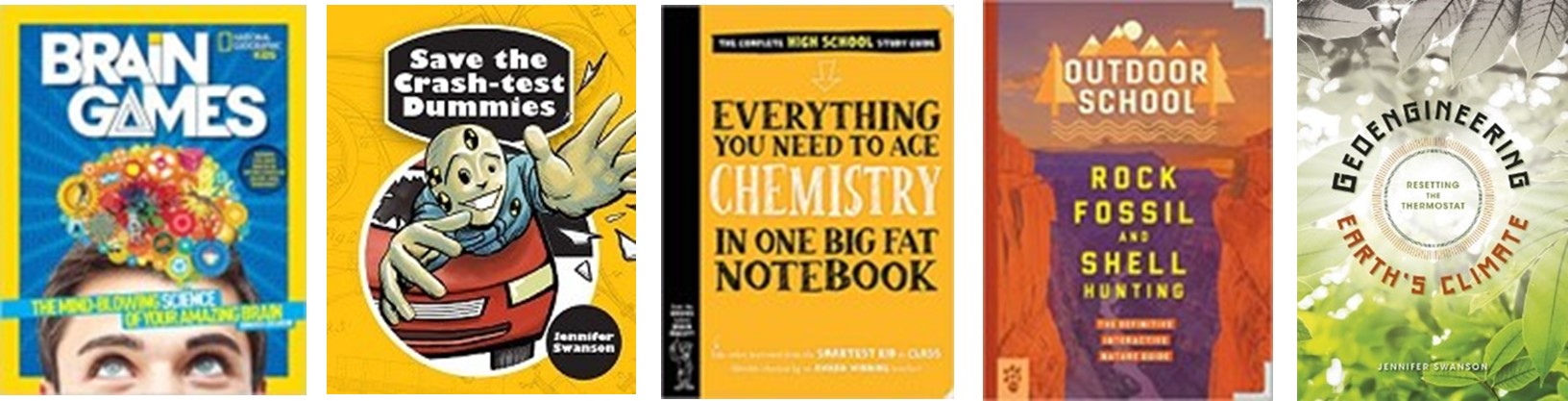
   Jennifer Swanson is the award-winning author of more than 50 books for children. Her awards include: three Florida Book Awards, a Parent’s Choice GOLD award, a Kirkus Best Book of 2021, AAAS/Subaru Prize semifinalist, and multiple NSTA BEST STEM awards. Jennifer is the founder of the STEMTuesday blog, STEAMTeamBooks, and the Solve It! for Kids podcast. She has presented at NSTA conferences, the Atlanta Science Festival, the World Science Festival, and the Library of Congress' National Book Festival.


WHO ARE THE SIX PENS?


Who we are? Then and now?

This is Laurie Lazzaro Knowlton and I thought you all might enjoy a little back story on the members of Six Pens.

When did you first get the itch to be a writer?

Laurie: I got hooked on writing in fifth grade. In ninth grade I had a very encouraging teacher, but it wasn’t until I became a kindergarten teacher that I decided to try my hand at writing.

What I didn’t do initially was my homework. I assumed that because I read multiple stories to my
children daily that I would automatically be able to write. So, my first story had two main characters, two main points of view, and the plot was meager at best.

What I learned was I needed to go back and educate myself. I attended classes, workshops, conferences and read every how-to book I could get my hands on. Probably the best three resources for my education were: attending a Highlights Writer’s Conference, initiated by Kent Brown, joining The Society of Children’s Book Writers and Illustrators, and reading every How To Write For Children book available.

As a result of attending events I found the networking, the encouragement, the critiques, the speakers, the rejections all worked together for my eventual success. It took me a total of 12 years of stumbling, educating myself, participating in critiques, classes, and conferences, submitting, and receiving piles of rejections before I finally accomplished my first published book, Why Cowboys Sleep With Their Boots On, Pelican Publishing, 1994. Since then I have had 62 titles published in the trade, craft, educational, Christian, and work-for-hire markets.

What advice do you have for people wanting to become writers?

Laurie: 1. My best advice is to educate yourself. Read, read, read!

2. Attend every conference, workshop, library speaker, in your genre that you can afford to participate in.

3.Allow your work to be critiqued. Do not defend your work. Listen. Then incorporate what rings true to you.

4. Be tenacious. Do not give up when you receive a bad critique, or another rejection. Listen, learn and keep moving forward. The people who make it in the field do not give up.

Best part of being an author?

Laurie: When I see a child listening to or reading one of my books.

Worst part of being an author?

Laurie: Having books go out of print.

http://www.laurieknowlton.com/


Gloria G. Adams

When did you first get the itch to be a writer?

Gloria: As a kid, I always had my nose in a book. The local library was practically my second home and authors were my heroes. I dreamed about becoming a writer when I grew up and even majored in English in college. But I was steered away from writing as a career and ended up eventually becoming a children’s librarian.

I loved my library career! But I never lost my dream of becoming a writer. I made up a lot of my own stories for story hour and, as I read picture books to my preschoolers, hoped that someday a librarian would be reading books in story hour that were written by me.

I was fortunate to have my dream come true! But getting there was a long journey. I remember thinking that it would be easy to write picture books since I had read so many over the years as a librarian. Boy, was I wrong!

 I had a lot of learning to do. I took writing courses, read books on writing, joined SCBWI and was fortunate to find not one, but two critique groups with amazing authors. One of them started as a mentoring group led by prolific author, Laurie Knowlton, from whom I have learned so much. And of course, I wrote and rewrote and…well, I’m still learning, taking webinars, reading articles, and writing and rewriting. I’ve found that the writing community is all about sharing, teaching, and encouraging.

I have a great agent and have been published traditionally as well as independently through my self-publishing company, Slanted Ink. I also started a critique editing company with a partner, author Jean Daigneau, called Two-4-One Kid Critiques.

What advice do you have for people wanting to become writers? 

Gloria: Learn all you can, not just about writing, but about the publishing business. Join writing/critique groups and professional associations. Read the kinds of books you want to write and practice, practice, practice.

Best part of being an author? 

Gloria: Seeing my books on the shelf at the library where I used to work, finding out that one of my books helped my great nephew with his reading, and finally being able to say, “I’m an author.”

Worst part of being an author?

The frustration of having editors want your book, but then the book getting turned down by the acquisition department.

https://two4onekidcritiques.wixsite.com/mysite

https://www.gloriagadams.com/  and  https://www.slantedink.com/


Lisa Amstutz

When did you first get the itch to be a writer?

Lisa: I always loved to read and kept a journal intermittently as a kid, but never thought about writing until I was in my 20s. Then I proceeded to read every book in three local libraries about writing. However, it took me 10 years to work up the courage to submit something for publication. Once I finally started, I wrote for magazines and the local newspaper for several years before venturing into books. In 2009, I discovered the world of children’s writing and haven’t looked back! 

What advice do you have for people wanting to become writers?

Lisa: Don’t let fears and insecurities keep you from your dreams. Do your homework – go to the library, take classes if you can, and look for resources online to help you learn the craft of writing and understand how the market works. And don’t give up – the first stories you write may never sell, but each one will teach you something. Writing is a journey, not a sprint. 

Best part of being an author?

Lisa: Connecting with readers is definitely the best part!

Worst part of being an author?

Lisa: Rejections. But they are just part of the process for a working writer.

https://www.lisaamstutz.com/


Kate Carroll

When did you first get the itch to be a writer? 


Kate:  I can’t say exactly when I wanted to BE a writer, but it was always my favorite subject, next to reading. I pursued a career in elementary education and found myself writing supplemental stories for my struggling second grade readers and penning plays for my class to perform. I didn’t think of it as writing, but more of way for my students to succeed at learning.
One fall, I needed cce credits, so, I randomly took an online class on creative writing.  That was the first time I realized writing was more than a solo activity. The professor encouraged us to share homework, support each other and join professional organizations like SCBWI. Which is what I did, and which is where I met my fabulous fellow pens. 
That first SCBWI conference caught me swimming in water way over my head. But I didn’t care, I was hooked. Slowly, I began to understand the challenges of writing for children. In fact, my first ever critique was a disaster. I think the editor was as stunned and didn’t have much to say except to tell me that most of my story was missing!  Shaken but undaunted, I kept diving into the deep to learn the lessons of plot, character development, climax, theme.  I never stopped believing that I could produce some publishable work. 
Five years later, I sold to Cricket Magazine, followed by Highlights and Faces Magazines, I picked up credits and the courage to keep going, to keep studying the craft, to keep tapping into the world around me and to lean on my kid lit crew. Even as an agented writer, my work ethic remains the same. My picture book hopes loom large… stay tuned for that big news!

What advice do you have for people wanting to become writers?

Kate: Study the craft. Whether you want to write picture books, middle grade or YA, learn everything you can about the genre. Read books, dissect them and repeat. 
Develop a community – even if it is only one fellow writer. Be brave. Have a thick skin. It will help your manuscript in ways you can't imagine.
Be patient! Success rarely happens overnight.

Best part of being an author? 

Kate: I love that my writing can be an unforgettable part of a child’s life.

Worst part of being an author?

Kate: Not having the time to write when I get an idea brewing in my head.

https://ktcarroll.com


Lana Wayne Koehler

When did you first get the itch to be a writer?

 Lana: I always remember writing but never thought about doing it professionally until I wanted to share a particular story that I had written. I attended a writer’s group at my community library and read my story. I got what I now know was a kind reception and from there, caught the bug to improve.

I began to hang out with other writers and listen to their stories of encouragement and defeat and
realized that I knew nothing about the craft that I wanted to pursue.

From there, I joined writer’s groups and local organizations like SBWI. I began to attend classes and conferences and met many others who had a thirst for learning more about writing. I had finally found my people!

I went to a Highlights retreat in Honesdale, PA, and began to really work at my craft. There, I met editors, agents, and fellow writers and learned how to hone the craft I was starting to understand.

What advice do you have for people wanting to become writers?

Lana: Read what you want to write. See what others have done with your genre. Research your subject matter. Become an expert in every story you want to write.

Best part of being an author?

Lana: Sharing what I have learned by writing what people want to read and meeting those readers! I once asked a little boy what his favorite animal was from my book about allergies and he said, “The rabbit.” My book didn’t have a rabbit in it. I found, after close inspection, my illustrator had included a rabbit on the cover. Always trust your readers opinions!

Worst part of being an author?

Lana: Putting time into a project and not finding an editor who was interested. It can be hard to remain optimistic and persistent in the face of rejection.

https://www.amazon.com/stores/author/B01C21HZRU/about


Gloria Reichert

When did you first get the itch to be a writer?

Gloria Reichert: I am not sure I can precisely pinpoint when I realized I wanted to write. It seemed to evolve. In high school, I had to write a theme every week for four years, and during college, as an education major, I was always writing something. My last quarter I had 14 papers to write! Writing was a part of my life. My desire to write for children became apparent during my teaching career. Using picture books as part of my teaching made me realize and appreciate the value of this genre. I came to regard them as little books with big ideas. I remember stating to my students that one of my goals was to write picture books. I still have a thank you note written by one of my students at the end of the year. In the note, she wishes me good luck in writing picture books.

Once I left teaching, my first step in my quest to write for children was to contact the local library to see what direction they could give me. They suggested I contact the wonderful Laurie Knowlton. (Actually, I remembered her, since she had taught a workshop I attended as a teacher.) When I spoke to Laurie all those years ago, she advised me to join The Society for Children’s Book Writers and Illustrators and to educate myself by reading books on the craft of writing. I took her advice and participated in workshops of all kinds and did all I could to hone my talents. Educating myself as a writer continues to this day.

What advice do you have for people wanting to become writers?

Gloria Reichert: Those who wish to become writers should educate themselves and find a critique group. It is also important to keep reading, not only books in the genre in which they wish to write but also current adult writing. Never give up. Be persistent. There is not one published author who ever gave up.

I also think it is important not to compare yourself to other authors. All of our roads to being published are different. Our uniqueness will eventually make our work stand out.

Best part of being an author?

Gloria Reichert: I appreciate having fun when creating, wordsmithing, and challenging myself to make my manuscripts better. I also appreciate knowing that my words have the potential to change a child’s life for the better in some way. As I have participated in workshops, conferences, classes. and critiques, I’ve met many other authors and illustrators who are among the kindest, nicest, people in the world.

Worst part of being an author?

Gloria Reichert: To me, rejections and all the time it takes to hear from editors are among the worst parts of being an author.

https://www.gloriareichert.com/